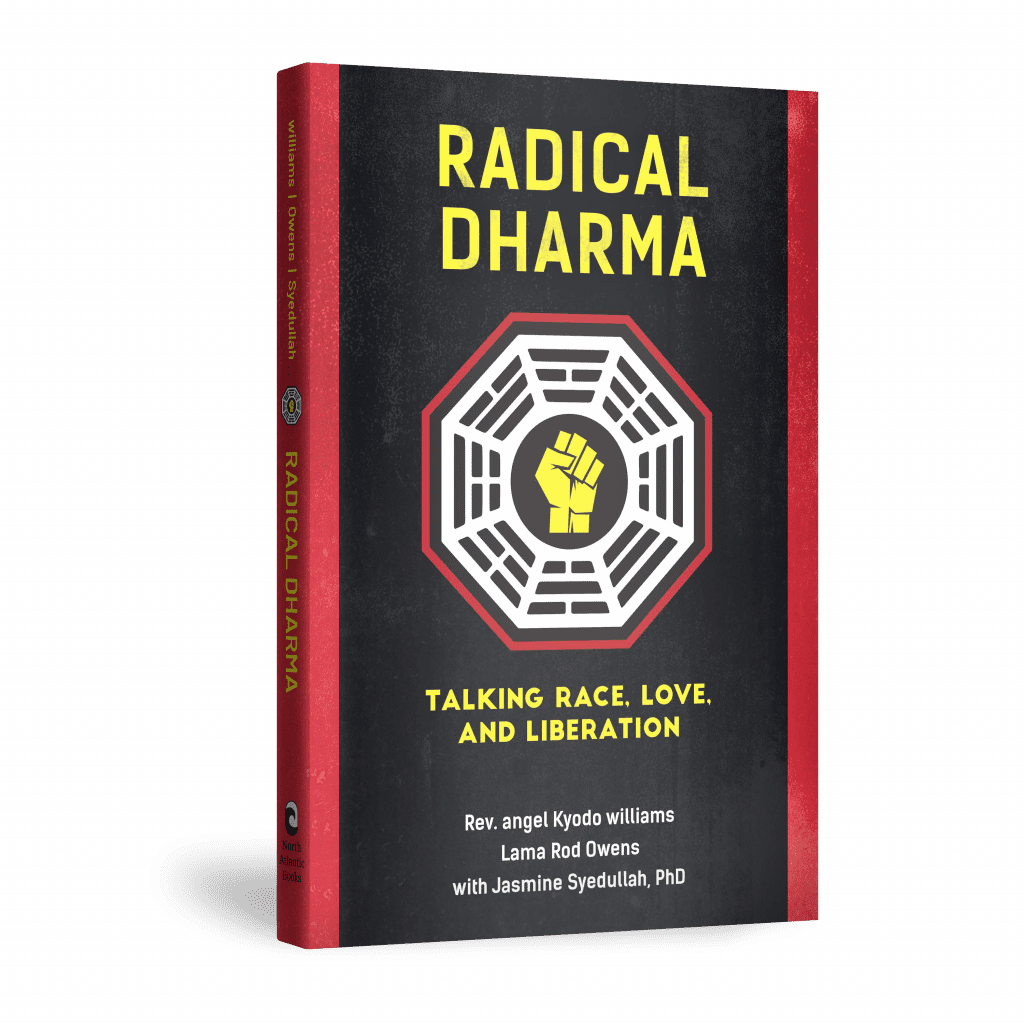
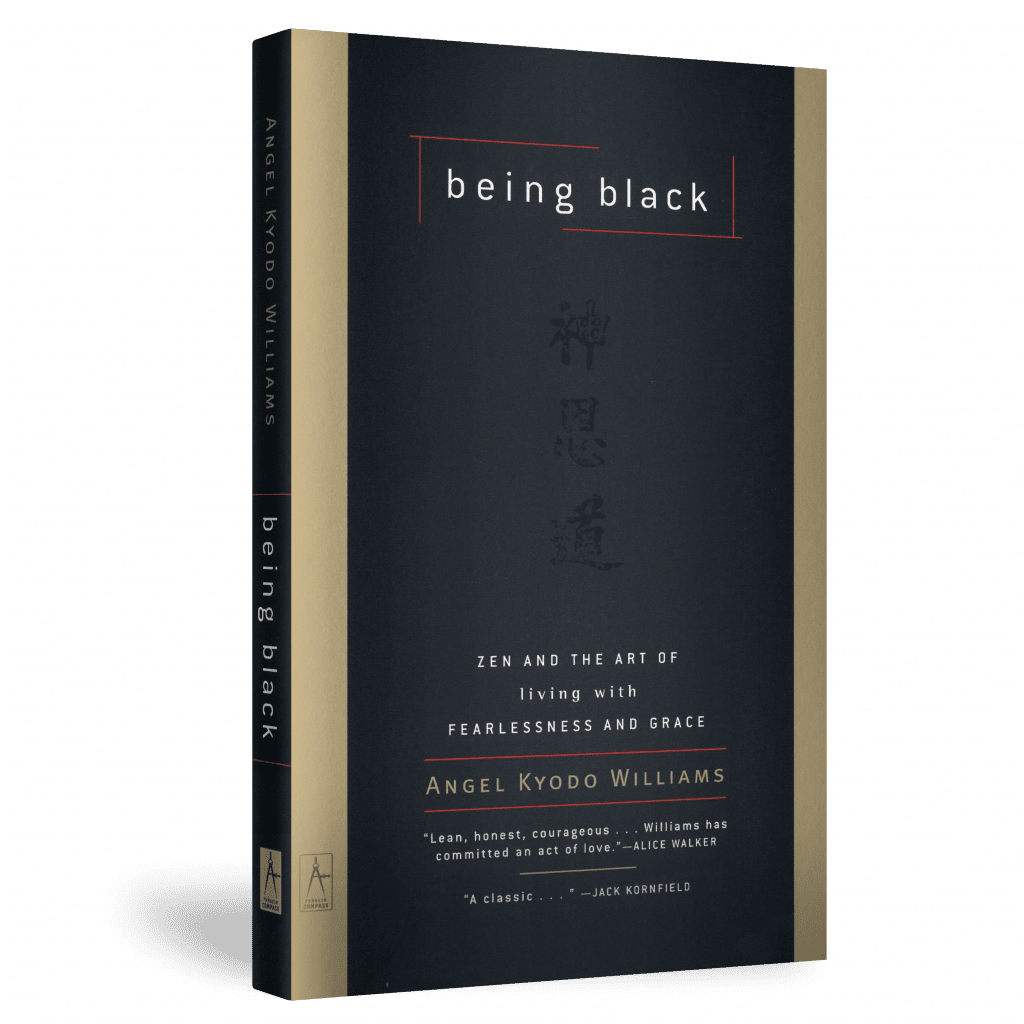

I May Not Stay Here With You: Transmitting Dharma Beyond Race

By the time this article reaches you, I will have been empowered as an independent teacher in the Zen tradition through a ceremony and process called dharma transmission. While Zen has flourished in the West long enough to bear witness to the passing of pioneering teachers who have, in turn, seeded a substantial network of second- and third- generation teachers in America, my own rite of passage remains noteworthy for dubious reasons. As the second African-American woman—and only the third black person in America—ever to receive this empowerment in Soto Zen Buddhism, I am acutely aware of the conflicting viewpoints with which I hold it.
Arising out of the cultural needs and priorities of seventh-century China, the Zen school places significant emphasis on mind-to-mind transmission. The transmission ceremony affirms one as a successor in a lineage reputed to be unbroken from the historic Buddha to Mahakashyapa in India, through to Bodhidharma and Huineng in China, to Dogen in Japan, and in my case, Taizan Maezumi Roshi and Bernie Glassman Roshi in America. One of the essential rites of this passage is to hand copy and receive back a stamped bloodline document that traces this lineage in a chart of swirling lines ending with your own name, effectively “sealing” one’s authentic place of belonging in this eighty-plus-generation family.
While it has long been established by scholars that the lineage as written couldn’t possibly be historically accurate and therefore literally true, any teacher undertaking the ceremony would be hard-pressed to deny that a mysterious and visceral comfort attends the affirmation of one’s belonging, regardless of its being symbolic and maybe even precisely because it is.
In this way, I am no exception. After ten years of mostly avoiding the Buddhist main- stream while dealing with the demands of starting up a small dharma community and being a full-time residential teacher, I had become accustomed to going it alone. The public acknowledgement of what one already is, what is already so, is very much like getting married to a long-held beloved: at the end of the ceremony, you return to the place you’ve always lived, but now it is truly your home.
Still, I observe any system of perpetuating a special transmission with the wary eye of a justice-seeking person who has existed in a multiplicity of categories that are famously marginalized in America: black, female, queer, working class, non-degreed, and under-resourced. It doesn’t take deep analysis to recognize that inherent in the tradition passed through this lineage are handy tools for keeping in place the structures that hinder healthy diversity because of the unwelcoming conditions that exist when black folks and other people of color find themselves trying to pierce the veil of all-whiteness we still find in the vast majority of convert dharma centers. This transmission system—different from formal participation and merit-based curricula such as the Community Dharma Leaders program offered through Spirit Rock—also has embedded within it the potential to foster, then obscure, discrimination under the guise of authenticity.
To this end, when establishing the New Dharma Community as a home for people committed to deep practice of the dharma and also to deep change for a more equitable and just society, we took up the story of the historic Buddha touching the earth in the bhumisparsha mudra, facing down the darkness of Mara, as our symbolic transmission. In
doing so, we affirm our belonging to the lineage of awakening that precedes even the historical Buddha, much less that of white teachers who have withheld such belonging, if for no other reason than because the dullness of their unexamined privilege has prevented them from being able to see those who are unlike them.
Mara challenged Gautama’s right to ascend the seat of enlightenment, just as the dominant white paradigm showers arrows of comparison that challenge the culture, beliefs, and ways of other people, viewing them as inferior to their own. While many people wish to paint over the blight of racism that permeates the Buddhist community by casting it under the rug of a misguided fixation on identity, it was the Buddha himself who expressed an awareness of the need to address race, caste, gender, and class oppression by modeling the path to liberation. In reaching down and touching the earth, the Buddha of that time, and all of the buddhas who follow his radical example, are witnessed by the earth itself and join a sacred, timeless, and unshakeable lineage of liberation—one that is evidenced both inside and out. The earth shudders in approval.
I will continue to view the mantle of being an “authenticated” teacher with equal parts wariness and humility, as yet uncertain about whether it is best to crash the “sameness” party with healthy doses of difference or if it is of greater service to simply remain on the outside. To paraphrase Martin Luther King, Jr., “I may not stay here with you.” But no matter my personal choice, it seems the challenge established by the virtues of wisdom and compassion, and the very integrity in our practice—not to mention the radically changing world we are in that clamors for true justice—demands that the greater Buddhist sangha vigorously and wholeheartedly takes up the question. If we do not, the powerfully persuasive draw of these ancient teachings will be overwhelmed by the deep misalignment of racism and oppression. But if we do, our collective transmission will be that much more radiant, powerful, and true.
This essay was written as Commentary for Buddhadharma, Winter 2013 issue.
Original article appears here: https://www.thebuddhadharma.com/web-archive/2013/11/12/commentary-i-may-not-stay-here-with-you.html
Download the PDF here:akwilliams-buddhadharma_winter2013
I May Not Stay Here With You: Transmitting Dharma Beyond Race

Why Is American Buddhism So White?
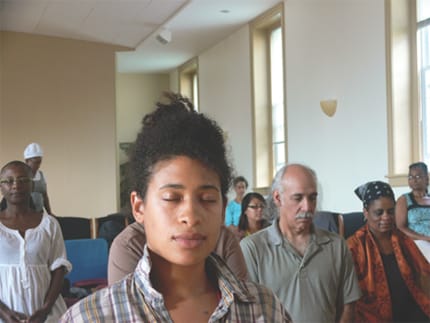
can you see me now?

Just three days after the New York Post’s brazenly racist cartoon managed to slip past all editorial checkpoints to subtly (or grossly) depict the nation’s first Black president as a rabid chimp gunned down by NY’s finest, the online Opinion section of NYTimes ran an article on race. Columnist Charles Blow doesn’t mention the Post snafu, likely because his piece was already written just as the shit was hitting the proverbial NY fan. Publisher Rupert Murdoch hadn’t even taken out his shovel by the time Blow was taking exception to newly-appointed Attorney General Eric Holder’s scathing comment about America being “a nation of cowards” when it comes to race.
Rather than naked racism, Blow draws our attention to the implicit bias that undergirds our national conversation on all things black and white. There’s nothing new about how lopsided the pages Blacks and Whites are on when it comes to perceptions of racial equality. It is disturbing to see in hard figures the six years and hundreds of thousands of peoples worth of data that reveal Asians and Latinas run almost neck-and-neck with Whites when it comes to having an implicit pro-white bias. Fear of A Black Planet is alive and well. Thanks to slippery ol’ internalized racism, a good chunk of Blacks are pro-white too, though they were also the most likely to be neutral.
Well, Black folks kinda knew this through direct experience all along, but how did science get to the bottom of what most of us won’t or can’t reveal about ourselves? A simple 10 minute, 2-fingered test that anyone that cares about social justice should take. Now. Don’t Pass Go. I’ll be here when you get back…
As self-declared activists, allies and agents of social change, many of us will feel sheepish taking the test, even behind the privacy of our computer screens and (mostly) anonymous browsers. With our cool collaborations and coalitions, we’ve taken a certain amount of comfort in being able to self-righteously stake a claim to our good standing on the racial bias spectrum.
We’re mostly beyond the once-too-familiar wannabe-progressive White folks declarative “I don’t see color” claim. (In case you were wondering, this is not a good thing. Since we are, in fact, “of color,” not seeing color means not seeing me. What I hear you saying is you’re trying to see me just like you see white people. Um, no, thank you. On the other hand, the only thing worse than being seen as something you’re not, is being transparent, as in not being seen at all.)
Speaking of “of color,” now that we of the many ethnicities and hues–East and Southeast Asians, Latinas, Middle Easterners, Natives and Blacks, not to mention mixed race, mestizos, and mulattoes–have successfully lumped ourselves together into the One Big Category of People of Color for political purposes, our other-than-Black brothers and sisters often receive a pass to bypass their anti-Black bias by vague reductionist association. That escape hatch leads to a dangerous rabbit hole of weirdness, guilt and confusion for all.
Even Black folks can no longer hide behind the mere fact of birth to escape the taint of racial bias that, while not exclusively American, we’re the best at marketing worldwide.
The repercussions of this are hard to discount. Obviously this is a social change issue at its core because the work for a truly just society for all requires trusting alliances. But it’s even more of an inner change issue because we know that no matter how many campaigns we win or laws we pass, real justice begins right here, in our own hearts and (unconscious) minds.
Look to Cuba where institutional racism was systematically written out of the laws within months of the ’59 Revolution, yet they must acknowledge the naiveté of believing discrimination could be legislated away:
“…we believed at the beginning that when we established the fullest equality before the law and complete intolerance for any demonstration of sexual discrimination in the case of women, or racial discrimination in the case of ethnic minorities, these phenomena would vanish from our society. It was some time before we discovered that marginality and racial discrimination with it are not something that one gets rid of with a law or even with ten laws, and we have not managed to eliminate them completely in 40 years…”
—Fidel Castro
Science’s answer to ameliorating implicit bias? Distinguish. When people are taught to distinguish individual faces of people of races other than their own, the inclination to make cross-the-board associations–negative or positive–is diminished. People are thus returned to their rightful place as unique, individual beings that have to be taken for who they actually are rather than who they generally are or might be.
I went to junior high with an 84% Asian population in the heart of New York’s Chinatown. As a bonafide minority, I couldn’t get away with blending the Taiwanese, Hong Kongers, Han Chinese and various Pacific Islanders with a cavalier “they all look alike to me.” I had to see each of them. One by individual, unique one. Being in real relationship with “the other” closed the bias gap.
But to even get there, we have to look at ourselves first. We have to stop letting ourselves off the race hook and commit to actively resisting the biased waters we swim in by raising our unconscious, implicit fears to the level of conscious, explicitly articulated ones. That’s painful, exhausting, heart-breaking work, but it’s the real work that needs to be done. No less important than your next action, petition, campaign or board meeting. (Those explicit biases could use a good eyeballing here, too.) Plainly speaking, if you’re doing work for change in what’s “affectionately” referred to as AmeriKKKa without a practice of examining race, you’re pretty much adding to the problem.
We can and should do the good, hard work of rooting out systemic oppression and racism at all levels of society. But not unless and until we address the ultimate system–the inner thoughts, feelings and beliefs that give rise to our implicit perceptions–will we have a chance at the deep change that can–and will–elude all of our political maneuvering.
Take a good look at you so you can take a look at me.
Can you see me now? Good.
—
copyright ©MMXI. angel Kyodo williams
changeangel: all things change. (sm)
angel Kyodo williams is a maverick teacher, author, social visionary and founder of Transformative Change.
she posts, tweets & blogs on all things change. permission granted to retweet, repost, repast & repeat with copyright and contact information intact.
Faceboook: Like angel on Facebook
Twitter: Follow angel on Twitter
Web: Find angel on the Web
Blog: new Dharma: live, love & lead from the heart
Train: Train Your Mind with angel