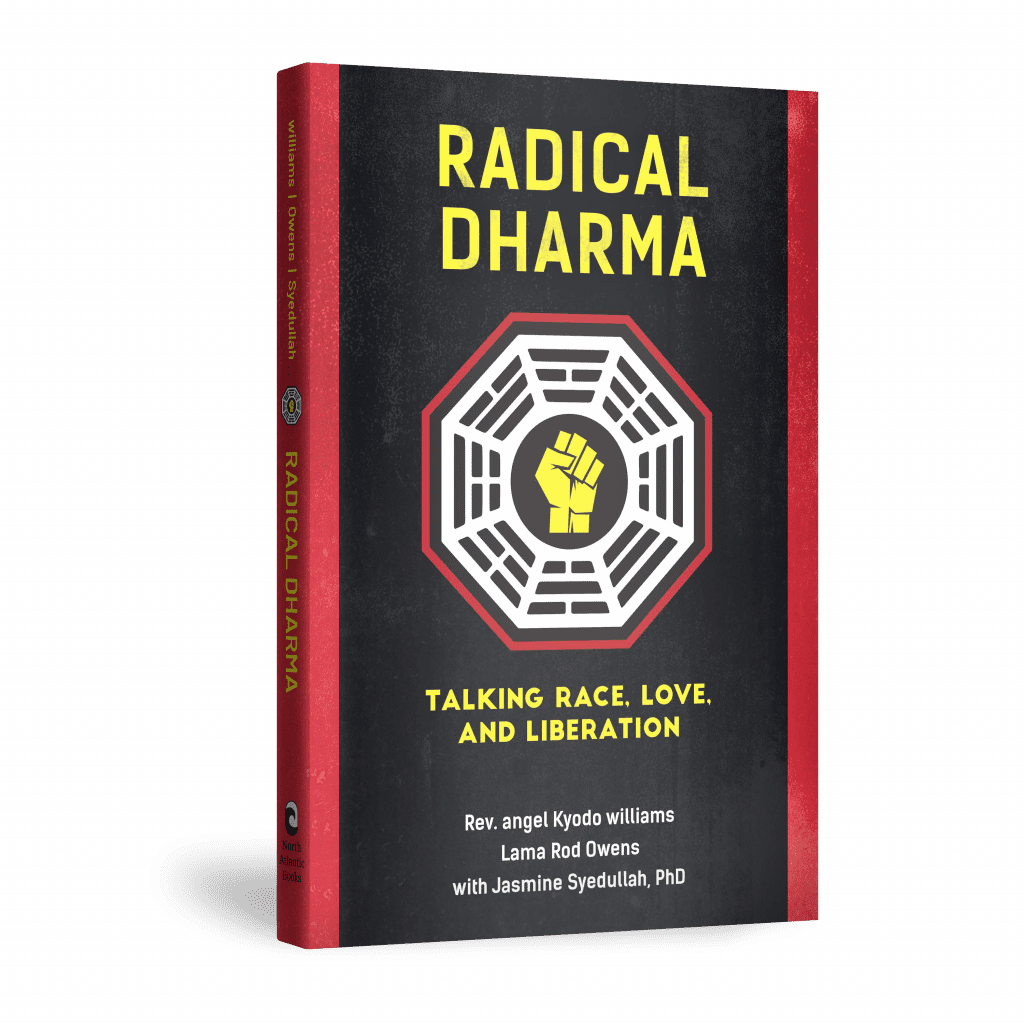

How to Lead Like a Spiritual Warrior An Interview With angel Kyodo williams
 An Interview With angel Kyodo williams
Zen teacher, activist, and author of Being Black: Zen and the Art of Living with Fearlessness and Grace angel Kyodo williams says we can be the kind of leaders that reduce burdens not create them.
Omega: To be a spiritual warrior—an archetype in all traditions—you’ve said we need to “transcend the stories we make up in our own minds about ourselves and our shortcomings…. It’s the labels that we apply and that are applied to us that box us in, break us down, and wear us out.” How does this apply to women, specifically, who want to act in service to the greater good?
angel: We all get handed these stories, right? Every one of us—we’re born into a family, a time, a region, a culture. We get handed a story about what we look like. As we express our capacities we get stories about whether we are more or less capable. Not only do we get individual stories, we get collective stories. We miss a great deal when we only pay attention to the story that’s been handed to us and we’re not intimately connected to the deeper story of who we really are—as Buddhists say, before our mother was born. We come encoded with a deep memory of who we’ve always been but when we arrive on the scene our focus is turned toward the external. We forget we have that operating information about who we always are.
In this society and age—even as we have fought and pushed back and challenged it—women have taken on the story of being inferior to men, of the inability to accomplish things without men. Many of us have taken on the story of needing men in order to feel complete in a sexual or romantic way, and the story of the impact that the treatment of men and fathers have on us. This is something that we carry forward with us and there are limitless possibilities of what kind of stories those could be, good and bad.
But we have been uniquely gifted as women with an embodiment of receptive energy—the ability to be receptive where stillness can arise. Feminine energy enables containing and holding and opening up the space to allow more and others in. Because—whether we do it physically or not—life ushers forth, creativity ushers forth, from the feminine. And because of that we are intrinsically oriented against destruction of life and of creativity.
Of course there are natural, creative destruction cycles. But because creativity ushers forth from the space of the feminine we know that it isn’t our role to interrupt the creative flow. So it is women that are much more likely to insist on the justice that is necessary for us to have a thriving society that is spacious and equitable for all people. Because the energetic life force ushers forth from us, we understand that it all has a right to be here and a right to thrive until it’s natural, organic cycle comes to an end.
So women have a responsibility to set these stories—that hinder our responsibility and limit our role as the carriers of creativity, as the generators of a greater and greater container that can hold all of life—aside.
Because these stories are fairly random, right? I got born this time to these people in this culture in this society. And I would have been someone different had I taken up the stories of another time, another set of parents, another region, another culture, another side of the country, speaking another language. So how much really of that is you? So why don’t we start choosing the stories that we’re going to take on? Why don’t we choose the stories that most enable and empower us to meet the fullness of our role and responsibilities as the energetic force that supports life and thriving and creativity?
Omega: Is this kind of spirituality an antidote to the “individualistic materialism” you say has become a form of religion in Western culture?
angel: Yes. Like a spiritual warrior, you have to get trained in the skills to interrupt this incredible organism of destruction. So I’m not saying people should just run out and start doing any old thing, but rather develop one’s capabilities. The capacity of the heart and the skill sets to be able to say, “I’m not going to be slayed by playing the game with a fantasy that that’s how to stop it.”
When we withdraw belief in the destruction, it will collapse. We have a deep habit. All the new books in science say if you want to stop a habit the best way is to replace it with a new one. If we can begin to work on strengthening the habit of tuning into, and moving, in love and self-care—healing the places of generational pain and suffering; healing the places of division in our own hearts that keep us separate from the people in our lives, and the people across the road, and across the border—if we develop those habits it will be much easier to divest ourselves of the habit of belief in this system of destruction.
Omega: How do leadership, power, and hierarchy function together in an equitable and holistic community?
angel: I think we’re naïve when we try to flatten something. Hierarchy is a natural response to the diversity of needs that exist in society and the diversity of attention in social orders. In order to focus attention and advance the needs of societies, communities, organizations, homes, families, etcetera, true leadership is a relief. Because it frees each of us to pursue the things we love with a sense of being able to entrust the steering of the ship—not over the edge of the world but pressing forth into the glory of the horizon and the possibilities of new oases of nourishment and places where we can have shelter and be creative and thrive.
So the best placed leadership reduces burdens rather than being a form of oppression. That’s the relationship I have to leadership and hierarchy in its best expression.
In the best situations leadership is not a fixed idea—one person leads forever. Rather an emergent leadership in which whoever is most suited toward the task at hand is the leader, people that came before or have particular capacities in that moment, and we all are developed and well socialized enough to follow well, be responsive to that leader, and relate to leadership not as something that hinders us but something that moves us forward. So we give over our full resources to make that leadership successful because the leadership is acting on our behalf. It’s not separate from us.
In terms of like social organizations, any organizations that want to engage in a just society that is in any contact with people that are marginalized must have those populations within its decision making body. Not just to act or advise but in decision making, meaningful capacities to exact power. Or those organizations and institutions are irrelevant. They’re just waiting to find out, because they’re already irrelevant.
It’s a very Eurocentric Western paradigm—we know what people need, so we know how people think. No, we need to know how people move in a space, how they sit at a table. Do they sit in circles or across from each other or in rows? All of that teaches the cultural expression and diversity. Diversity opens new windows of insight into how can we organize space for the whole. Everybody gives up a little bit of room so we can all fit into the circle comfortably.
As it turns out, we all don’t need the same amount of space so it doesn’t have to be equal. It has to be equitable. We don’t drink or eat the same amount. Some of us need to be in the sun more often. Some of us need access to art. We’re really different.
If we’re willing to be complex in our solutions and our willingness to look at things, and not be slave driven by economic imperatives, and slow down and meet each other—we can do this.
We forget. I fully trust that the people that seem like they don’t want to meet us have just forgotten. And we should hold space for them so that when they come to their senses and they remember, it’s safe for them and we’re not against them. We’re for them.
Read the interview here: https://revangel.com/talks/how-to-lead-like-a-spiritual-warrior-an-interview-with-angel-kyodo-williams/
How to Lead Like a Spiritual Warrior- Interview w/ Rev. angel

Threading Anger Through Love
 angel Kyodo williams, Zen teacher, activist, and author of Being Black: Zen and the Art of Living with Fearlessness and Grace, describes how we can practice shifting anger from a destructive to a generative force.
Anger is capable of pointing us back to love. It arises as a result of an offense to what we love. If we can use anger to reconnect to love, then that anger—the response that we have to injustice, pain, and suffering in the world—can be a generative force rather than a destructive one.
When we thread anger back through the core of what we love, the response can be fierce and powerful but not consuming. This is a very subtle point that is often not understood—that we can, in fact, have fierce responses that begin from a place of anger about injustices and pain that are greater than any person or community should have to bear. But, that anger must be taken and threaded through and then anchored and rooted in what we love. When we anchor it in love and allow ourselves to also be cognizant of the suffering that we are experiencing as a result of our loss, pain, and the injustice, we get back again to that place that doesn’t want anyone to suffer like we are.
So when yet another black child, teenager, or young person is killed, the response should be fierce. But if it’s rooted in love and that love is connected with a deep touching into our suffering, whatever the reaction, there’s no wish for destruction of life or for the suffering of others. Love has a wish for the deconstruction of that which is false and that which harms. That’s the right place to go. Love never expresses itself as wishing harm.
The nuance is challenging because anger is a fire energy. And it often burns so hot we’re not able to see through into love.
Looking Beyond Practice to Cause
I want to say, especially thinking about Martin Luther King’s quote about riots as a voice of people that have not been heard, that I’m making these observations within a privilege of not having had that amount of injustice hoisted upon me.
I would like to believe that if I were directly touched in a material way by these injustices, that having a practice and an understanding that arises out of that practice, would enable me to root my anger in love. To anchor it and take that thread and loop it in love so that my activity would manifest as a loving expression. But I cannot imagine or speak to what it means for people that haven’t had that practice and have had that kind of injustice. I can speak from the seat of comfort and privilege, but I’m not prepared to denounce in any way what it does to the human psyche, the human heart, when your humanity has been so denied.
I think we have to be careful about asking a humane response from people who have been dehumanized so often for so long, from the beginning of the building of this society.
We should endeavor to know what it is that produces serial killing at the rate at which it’s produced in this country, in this society. Do we blame the serial killers or do we blame the society when we know that the percentage is so high and so specific to our country?
I have a friend who says, “There is no personal experience.” There’s no such thing. And so I can’t demand of anyone a merely personal response. We can’t keep going along and saying, we are collective, we’re connected, and then say, but individually they should do X, Y, and Z. You’re not an individual. No one’s an individual. We’re all active in the web of actions, reactions, and experience.
Read the interview here: https://www.eomega.org/article/threading-anger-through-love
Threading Anger Through Love w/ Omega Institute – INTERVIEW

Wisdom in Action
Waking Up From the Mind of Whiteness
 “once you recognize that there is something else operating that is beyond your ordinary sight, don’t bother with the content. watch the pattern. the content is a distraction from you being able to see the vastness of the construct because if you could see it, it would begin to fail. PAY ATTENTION. this isn’t about ONE INCIDENT. #BlackLivesMatter “

-written as a comment in response to a white Buddhist practitioner’s inquiry about knowing when racism is present –aKw
as a Buddhist, you may get this: just as the ego-mind is a construct that constantly reinforces itself, building structures & systems of control and develops attitudes & views that maintain it’s primacy and sense of solidity so that it can substantiate its validity, so, too, does the construct of whiteness. one could think of it as the Mind of Whiteness. you live inside that Mind, such that you cannot see—yet—outside of the reinforcing perspectives that affirm and perpetuate the White Superiority Complex. that complex would disintegrate if it could view the vastness of the presence of racial bias. so you and the vast majority of progressive whites, and i daresay especially buddhists, remain blind and thus ask questions that are very much a part of the need to escape the sheer anguish of how pervasive it is, how you participate and how seemingly inescapable it is. but just as the ego-mind cannot be used to work it’s way out of it’s own construct, so too can the Mind of Whiteness not be used to see through the veil of its own construct. so we sit. and we feel. and we let what arises do so until the resistance is worn down, or moved through or even overwhelms us. on the other side, we see a glimmer of something that we couldn’t get a handle on for our desperate need to avoid it. we see Truth. and when we catch a hold of it, we see the patterns of our participation in not-Truth emerge. but with a steady mind and true heart, what is apparent to others begins to reveal itself and emerge from behind the fog of our Ego-Mind of Whiteness (that btw, plagues non-whites just as much in different, but debilitating ways). i tell my students: once you recognize that there is something else operating that is beyond your ordinary sight, don’t bother with the content. watch the pattern. the content is a distraction from you being able to see the vastness of the construct because if you could see it, it would begin to fail. PAY ATTENTION. this isn’t about ONE INCIDENT. it is about the overwhelming pattern that forms the fabric of our lives here in America and cloaks our individual and collective humanity. we have failed ourselves. don’t get caught in the trap of the sifting through the fascinating sparkly details when the whole thing is a failure. divest your interest in this failure so that you can begin to develop Right View so you can even begin to see the forest rather than holding on for dear life to a tree. the simple answer: race is rarely all of the story and ALWAYS some of the story in America. period. he should have been indicted because he killed an unarmed person. of any color. but because of the PATTERN, i woke up from the slumber of believing i might finally be safe. i am not safe. my brother is not safe. my father is not safe. because we are wearing this color of skin. if we do not simply submit, we may be killed and not even a jury of so-called peers will have to wonder. having to simply submit, though, means we are not safe. we live in a constant state of low/med/hi-level fear as a people and it is validated on a daily basis. here is the impact of the pervasiveness of the Mind of Whiteness as it is expressed from bodies white, black, brown and yellow and red: because of what i have been taught, shown, experienced on a daily basis in my own fairly privileged life, i don’t assume all cops are racist…i assume all white people are.
and in case it’s not abundantly clear, i know plenty of other colored folks are racist, too. we are ALL working the pain, suffering and misery that the inhumanity of this system of oppression has cast upon us. i also know that as the dominate group that benefits from the perpetuation of said system, it is good, well-meaning white folks’ complicity that keeps in place.
Waking Up From the Mind of Whiteness

Rev. angel Kyodo williams | Beyond Idiot ompassion
Rev. angel Kyodo williams is an ordained Zen Buddhist priest, spiritual maverick, author, activist, and founder of CXC (Center for Transformative Change), in Berkeley, California, which is dedicated to “changing the way change is done.” Rather than exhort spiritual seekers to become more politically active, CXC supports social activists in becoming more spiritual. This is the only way, Rev. angel believes, we will “flip the switch” in people’s hearts so that we treat each other and the Earth more compassionately. She sees “the application of inner awareness practice to broad-based social change as America’s next great social movement.”
I came across the Center for Transformative Change while searching the Internet for an alternative to a ten-day meditation retreat at Spirit Rock, which—work and finances being what they were—I couldn’t afford. CXC offered a no-cost “virtual” retreat called “27 Days of Transformative Change.” I was intrigued. I could pursue social change and spiritual growth simultaneously? Excellent! No need to clear my schedule and go on retreat; my activism would be my spiritual practice. Having experienced the benefits of cyber community while living in rural Washington, where my closest friends were like-minded people in cyberspace, I wasn’t dismayed by the idea of participating remotely. It was sweetly empowering to think there would beings of like intention three hundred miles away doing their work while I did mine. Still, when the virtual retreat began I was surprised at how touched I was by my remote sangha’s support: knowing that our practice leader blessed our intentions every day in the practice hall and feeling part of an intentional community stretching to be a little kinder, a little clearer, a little more grounded, more fearless, and ultimately, more effective.
The 27 Days also included weekly dharma talks by Rev. angel, which we downloaded as podcasts. While Zen is known for being inscrutable, Rev. angel’s dharma talks were clear. More to the point, they were helpful—addressing the actual challenges I was facing in embracing the humanity of people to whom I was politically opposed. So it made perfect sense to learn that Rev. angel’s dharma name, “Kyodo,” means “way of teaching.” She has a gift for making profound teachings relevant to daily life.
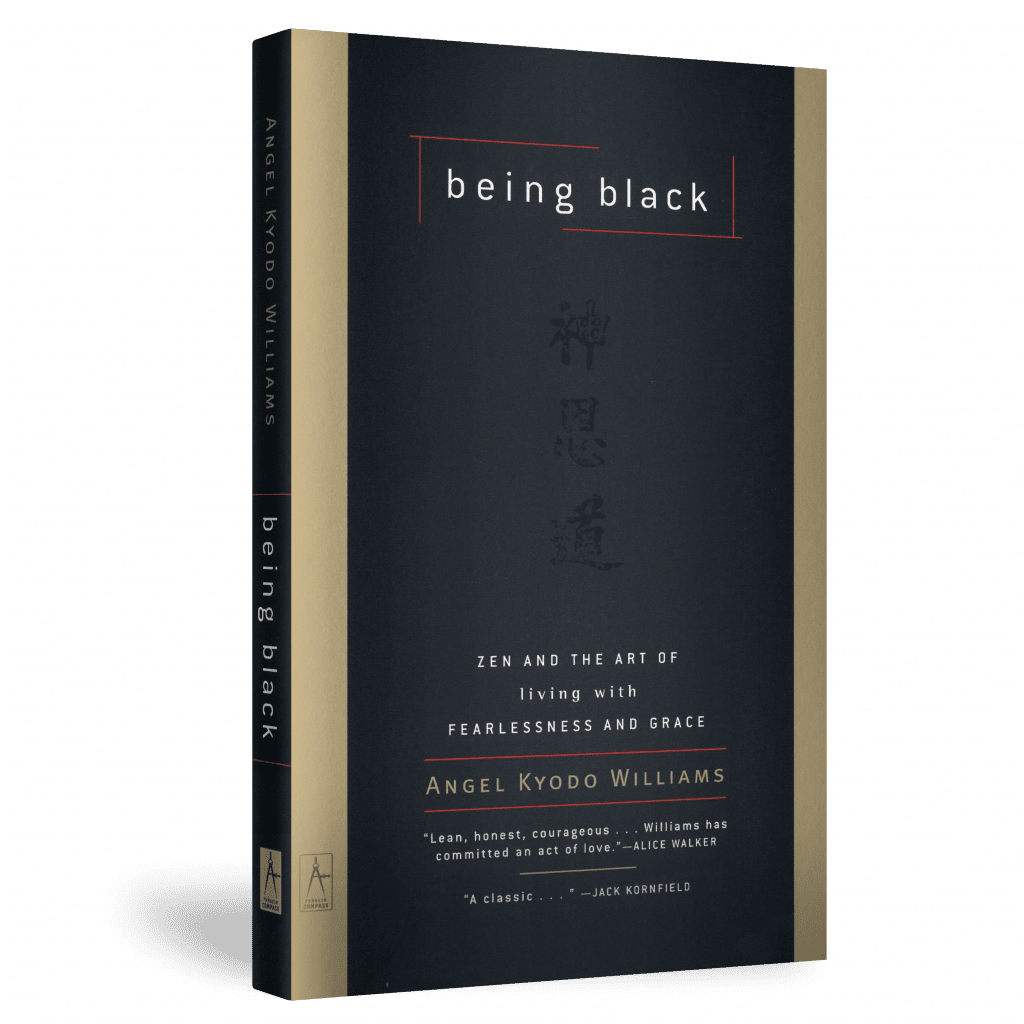
In addition to being the founder of CXC, Rev. angel is the author of Being Black: Zen and the Art of Living with Fearlessness and Grace, which has been called “a classic” by Buddhist teacher Jack Kornfield, and “an act of love” by novelist Alice Walker. The Library Journal has named Rev. angel “the most intriguing African-American Buddhist in America.” She was kind enough to speak with me by phone on four separate occasions. — Leslee Goodman
The MOON: Why were you drawn to Zen Buddhism?
Rev. angel: I stumbled across Zen Buddhism in my early twenties and really resonated with it, as if I was connecting with something that was already true within me. The underlying philosophy and feel of Zen, with its sparseness and precision, its supposed disregard of texts and of dogma, the silence of zazen—seated meditation—spoke to me very deeply. Also, my grandfather had recently passed, so I was in an especially quiet and internal place. I’d started my own little homemade practice and then found this container that could help me hold the depth of grief I felt, without a lot of interference from other people.
I became quickly enamored of the practice, dodged around and got connected with a community, and had a very strong, clear sense that I wanted to ordain—which I think might have been a holdover from women not being allowed to ordain within the Christian traditions I was familiar with.
I was particularly drawn to the aspect of service—specifically the service of keeping the liturgy. There was something profound for me about holding the space that keeps tradition alive. So I was ordained as a Zen priest within the Peacemaker order—and within a larger Zen tradition of being of social service. I knew this work landed squarely where I wanted my focus to be—the nexus of spirit and social service in the world.
Read the interview here: https://moonmagazine.org/rev-angel-kyodo-williams-beyond-idiot-compassion-3-2014-01-05/